by Lara Massó
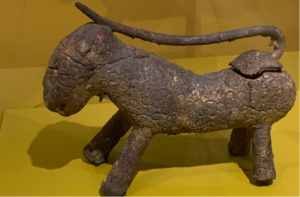
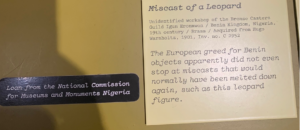 The Leopard is mentioned in the Podcast. It symbolises the greed of the colonisers. Photo taken in the MARKK Museum Exhibition “Benin. Geraubte Geschichte” (Benin, Robbed History). Every artefact in the exhibition is labeled with an exhibit label that states “Loan from the National Commission for Museums and Monuments Nigeria”.
This podcast thematises the looted art of Benin.The land of the Kingdom of Benin was subsumed into present-day Nigeria – a nation whose borders were drawn by colonial powers rather than by African political realities. Even though Benin was made a British colony, it has been closely intertwined with German colonial history. The podcast explores the history of the Benin Bronzes, then delves into their looting during the colonialism, and finally examines the ongoing efforts to enable their rightful return home.The Benin Bronzes were looted and dispersed across the world – though predominantly to Europe. An estimated 10,000 Benin artefacts exist, of which around 5,000 are listed in registers; some 1,300 of these are registered in Germany alone. Only 400 artefacts remain in Nigeria.
This history of colonial theft goes back to the 15th century. By that time, Benin was one of the most important kingdoms in West Africa. It was known as a powerful and highly sophisticated state with advanced political structures and vibrant culture. The kingdom had trading relations with Europe since the 15th century and became famous for its bronze and ivory artefacts. The kingdom established trade relations especially with Portugal, Netherlands, France and Britain. European countries brought knitted fabrics, Indian textiles, corals from the Mediterranean, metal goods and firearms. Then in 1897, British colonial troops occupied Benin. They violently occupied the capital and the royal palace and looted all the artefacts they could find. The year 1897 marks therefore also the end of the kingdom of Benin. Profitable trade with the kingdom did not satisfy the British anymore. The British forced the king of Benin (the Oba) to sign a treaty that legalised the actual theft of art treasures. Benin’s military only possessed light firearms with which Benin tried to protect itself. It was a very violent attack and the Oba had to flee the city.The British burned every village where they suspected the Oba might be hiding. In the space of a single day, the kingdom’s independence – along with its material cultural heritage – was all but destroyed.
For the podcast, we got the chance to talk to Prince Osaze Kelly Aiyanyor, activist and expert in the history of Benins looted art history, fighting tirelessly for the return of that looted art. With him, we talked about the meaning of the artefacts for the people of Benin and the importance of giving them back to their rightful owners. My deepest gratitude to him. He provided all his precious knowledge for this podcast and shared his visions about the ways in which the returning process should unfold. This podcast would not have been possible without his participation.
I would also like to thank the rapper and raptivist Monday Midnite, who generously made his song 1897 available free of charge to accompany this podcast. In the song, he calls for the return of the artefacts looted by British colonial forces from his birthplace, the Kingdom of Benin, in 1897.
 Monday Midnite. Rapper and raptivist. Image taken from Monday Midnite’s Spotify Music channel.
Sources:
-MARKK Museum Exhibition “Benin. Geraubte Geschichte“ (on site and online):
https://markk-hamburg.de/ausstellungen/benin-geraubte-geschichte/
-Digital Benin exhibition (Benin history from an indigenous perspective using Benin-authored sources exclusively):
https://digitalbenin.org/itan-edo
-Digital Benin exhibition (Archive of the artefacts): https://digitalbenin.org/institutions/24?id=24&page=9
-Song 1897 by Monday Midnite: https://www.agpnmusic.com/1897
-European Center for Constitutional and Human Rights e.V.: https://www.ecchr.eu/thema/koloniale-raubkunst/